

History of the Chicago Grid System: A Stroke of Urban Genius
Let’s rewind to 1909. Chicago was booming, but its rapid growth led to a maze-like sprawl that left residents and visitors scratching their heads and writing angry letters to town hall. Thinking, “Enough is enough!” Chicago’s city planners, led by Edward P. Brennan, took it upon themselves to devise a solution that would revolutionize urban navigation. They proposed a grid system so logical, so ahead of its time, that it's still the envy of city planners worldwide over a century later.
From making addresses easier to find to creating a framework for organized expansion and efficient public services, they designed a layout that would benefit all Chicagoans for decades to come. This grid became the backbone of Chicago's development and influenced everything from neighborhood boundaries to public transportation routes.
State and Madison: The City’s Compass
Located in the heart of the Loop (our central business district), the intersection of State and Madison serves as Chicago's central point. This crossroads, along with being geographically centralized, is also the conceptual foundation of our entire addressing system.
- East-West streets: Every address east of State Street is designated "East," while those to the west are "West."
- North-South streets: Addresses north of Madison are labeled "North," and those to the south are "South."
This simple yet brilliant system means that any address in Chicago immediately tells you its location relative to the city center. How convenient!
The Numbers Game: How Chicago Street Addresses Work
Chicago's grid system assigns 800 address numbers to each mile of streets. Why 800? It's not an arbitrary number, that’s for sure! It's based on the city's standard block length of about 1/8 mile or 660 feet. Eight standard blocks typically fit in a mile, with each getting 100 address numbers.
If that wasn’t ingenious enough, here's where it gets really smart:
- Odd numbers are always on the south and east sides of streets
- Even numbers are always on the north and west sides
So at a glance, you can quickly tell which side of the street an address is on and roughly how far down the block it is.
Distance Calculation Made Easy
Let's put this knowledge to work with a real-world example. Say you're at Foster Avenue (5200 North) in Andersonville and meeting up with friends at a trendy new spot on Division Street (1200 North). How far do you need to go?
- Subtract the lower number from the higher: 5200 - 1200 = 4000
- Divide by 800 (remember, 800 numbers per mile): 4000 ÷ 800 = 5
You're 5 miles away from your destination (better strap on some comfy walking shoes!)
Whether you're estimating travel time, deciding between public transit options, or figuring out if that apartment listing is really "walking distance" from your workplace, this calculation becomes second nature to savvy Chicagoans.
Primary and Secondary Streets
Chicago's street layout is like a well-designed circulatory system, with primary and secondary streets acting as arteries and veins. Primary streets run at one-mile intervals:
- North-South: Halsted (800 W), Ashland (1600 W), Western (2400 W), etc.
- East-West: Chicago Ave (800 N), North Ave (1600 N), Fullerton (2400 N), etc.
Secondary streets fall halfway between:
- North-South: Damen (2000 W), California (2800 W), Kedzie (3200 W), etc.
- East-West: Division (1200 N), Armitage (2000 N), Diversey (2800 N), etc.
This systematic layout creates a predictable rhythm that influences traffic patterns and even shapes neighborhood identities. Many of these primary and secondary streets are community hubs, lined with businesses, restaurants, and local landmarks.
South Side Quirks: Exceptions to the Rule
The South Side of Chicago throws a few curveballs into our otherwise uniform system:
- First mile south of Madison: 12 blocks (ends at Roosevelt Road, 1200 South)
- Second mile: 10 blocks (ends at Cermak, 2200 South)
- Third mile: 9 blocks (ends at 31st Street, 3100 South)
These variations reflect the older, pre-grid development patterns of the near South Side. After 31st Street, the familiar 8-blocks-per-mile pattern resumes all the way to the city limits at 138th Street.
Putting It All Together
Let's flex our Chicago navigation muscles with a more complex example. Imagine you're planning a bike ride from Jackson Park Golf Course (at 67th and Stony Island) to Bryn Mawr Country Club (at Devon and Pulaski). How far is this cross-city journey, assuming we stay off diagonal roads?
Breaking it down:
- First, go west:
- Start at Stony Island (1600 East, two miles east of State Street)
- End at Pulaski (4000 West, five miles west of State Street)
- Total westward distance: 7 miles
- Then, turn right and head north:
- From 67th Street (also known as Marquette Road) to 31st Street: 36 blocks or 4.5 miles
- From 31st Street to Madison: 3 miles
- From Madison to Devon (6400 North): 8 miles (6400 ÷ 800 = 8)
- Total northward distance: 15.5 miles
Total trip: 22.5 miles
This calculation shows how Chicago's grid system makes figuring out the distance of long treks a bit easier. It's a tool used by everyone from casual cyclists planning their routes to city planners designing bus lines and emergency services optimizing response times. It’s also great if you want to ride tech-free (goodbye Google maps!)
Mastering the Grid and Unlocking the City
Understanding Chicago's street system is more than just an interesting tidbit you can use to impress your out-of-town friends. It's also a fundamental skill that makes living in Chicago more streamlined and gives you the feeling that you are in touch with your city on a deeper level. When you can roam around without needing GPS or quickly estimate how long it will take you to walk from one apartment showing to the next, you’ll feel an unparalleled sense of freedom.
For instance, it can help you:
- Travel more efficiently: Whether you're driving, biking, or using public transit, you'll make smarter route choices.
- Estimate distances quickly: You can easily calculate how far you need to go, which means no more excuses for running late to dinner reservations at Alinea.
- Find addresses easily: When apartment or house hunting, you'll have a better grasp of location, commute times, and relative distances.
- Explore Chicago with confidence: You’ll feel much more comfortable venturing into new neighborhoods, knowing you can always find your way around.
Beyond these practical benefits, mastering Chicago's grid system opens up a new way of experiencing the city. As you navigate the streets with ease, you'll find yourself more attuned to the unique character of each neighborhood, the subtle shifts in architecture, and the pulse of city life. In essence, understanding the grid doesn't just help you move through Chicago, it helps you truly become a part of it.
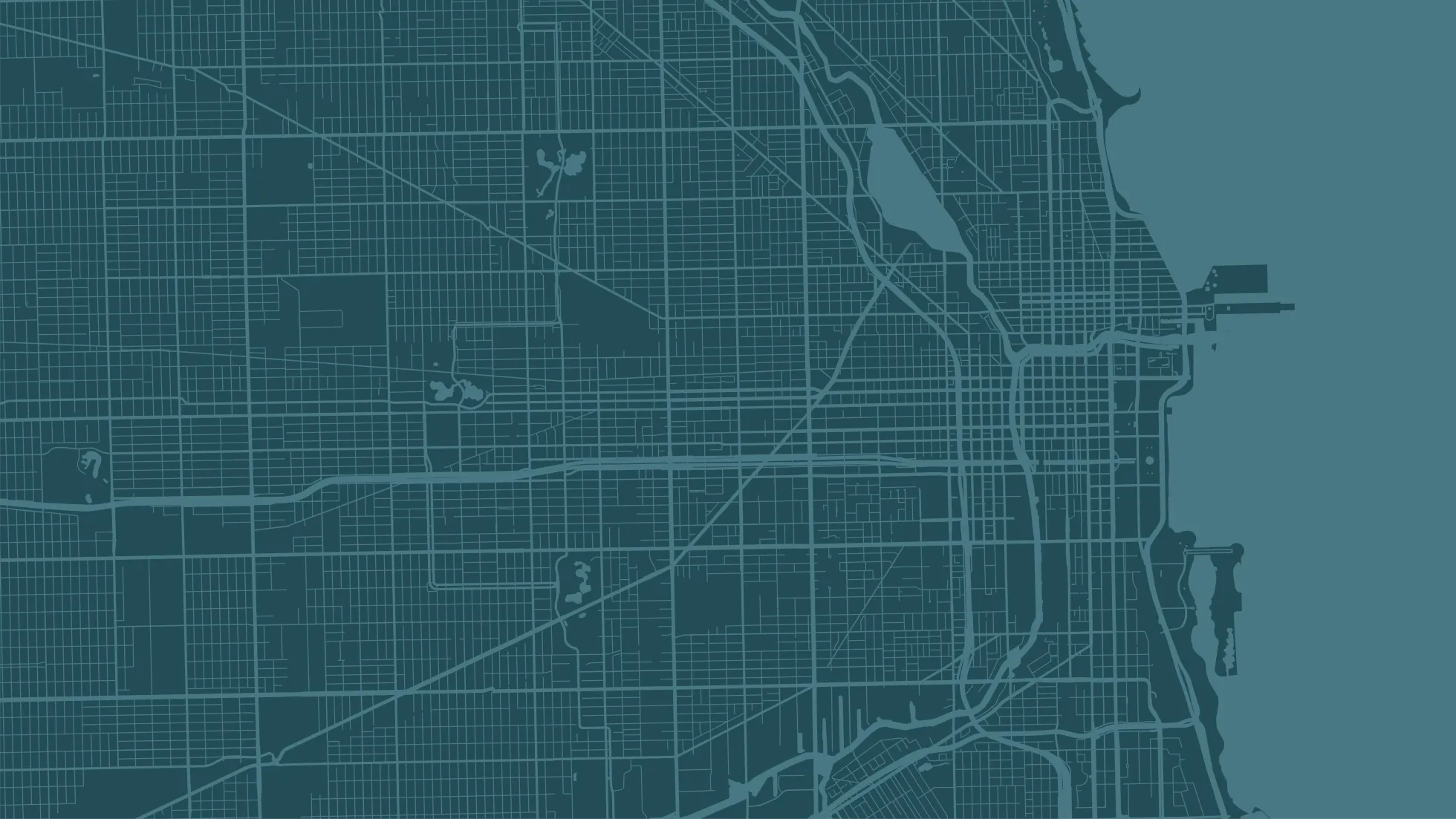
For a visual representation of how Chicago's grid system shapes our city, take a look at Domu's Map of Chicago Neighborhoods. This resource beautifully illustrates how the street layout influences neighborhood boundaries and community development. You’ll notice how major streets often serve as dividing lines between neighborhoods, and how the grid's uniformity (or occasional breaks from it) contributes to each area's unique character.
And if you need a handy-dandy Chicago street guide print-out to help soak this up, we have just the thing for you! Download the Chicago Street Guide:

Remember, like any skill, mastering Chicago's grid system takes practice. But once you've got it, you'll have unlocked a deeper, richer understanding of one of America's greatest cities.
Ready to put your Chicago grid knowledge to the test? Explore our Chicago Neighborhood Guides and find your perfect home in the Windy City. Whether you're looking for a cozy studio in Lakeview or a spacious loft in the West Loop, Domu has all the latest listings. Click here to start your Chicago apartment search and navigate the city like a pro!
Frequently Asked Questions About Chicago's Street System
Q: How do I know if an address is on the north or south side of Chicago?
A: Addresses north of Madison Street are labeled "North," while those south of Madison are labeled "South."
Q: What's the easiest way to estimate distance in Chicago?
A: Use the 800 rule: every 800 address numbers equal one mile. For example, the distance between 800 North and 1600 North is one mile.
Q: Are there any exceptions to Chicago's grid system?
A: Yes, the first few miles south of Madison Street have more blocks per mile. Also, some diagonal streets like Milwaukee Avenue don't follow the grid.
Q: How do even and odd address numbers work in Chicago?
A: Even numbers are always on the north and west sides of streets, while odd numbers are on the south and east sides.
Q: What's the significance of State and Madison streets?
A: The intersection of State and Madison serves as the zero point for Chicago's address system. All addresses are measured from here.
Q: How can understanding the grid system help me find an apartment?
A: It helps you quickly estimate distances from potential apartments to work, public transit, or other important locations without needing to look up each one individually.
Q: Do all Chicago streets follow the number system?
A: Most do, but some historic streets, especially in older neighborhoods, may have names instead of numbers.
Q: How does the Chicago grid system affect public transportation?
A: Many bus routes follow the grid's major streets, making it easier to navigate the public transit system once you understand the grid.
Q: Are there any tools to help me learn the Chicago grid system?
A: Yes! Our downloadable Chicago Street Guide is a great resource.
Q: How does the lake affect Chicago's grid system?
A: Lake Michigan forms a natural eastern border to the grid. Streets typically end at Lake Shore Drive, which runs along the lakeshore.