
A Step-By-Step Guide For Renters
Open the invite. Verify your ID. Get your reports. Here's how.
Before you start
Step 01
Open the invite from your landlord
Your landlord starts the process by sending you a screening invite from Domu. Check the inbox of the email address they have on file for you: the message comes from a domu.com address with a link that takes you to the start of your application.
If it's not in your inbox, check spam. If it's still missing, ask your landlord to resend it or confirm the email address they used.
Step 02
Sign in or create your Domu account
Click the link in the invite. You'll land on a page showing the property and the landlord who invited you.
If you already have a Domu account, sign in. The system checks whether your account email matches the email your landlord used to invite you.
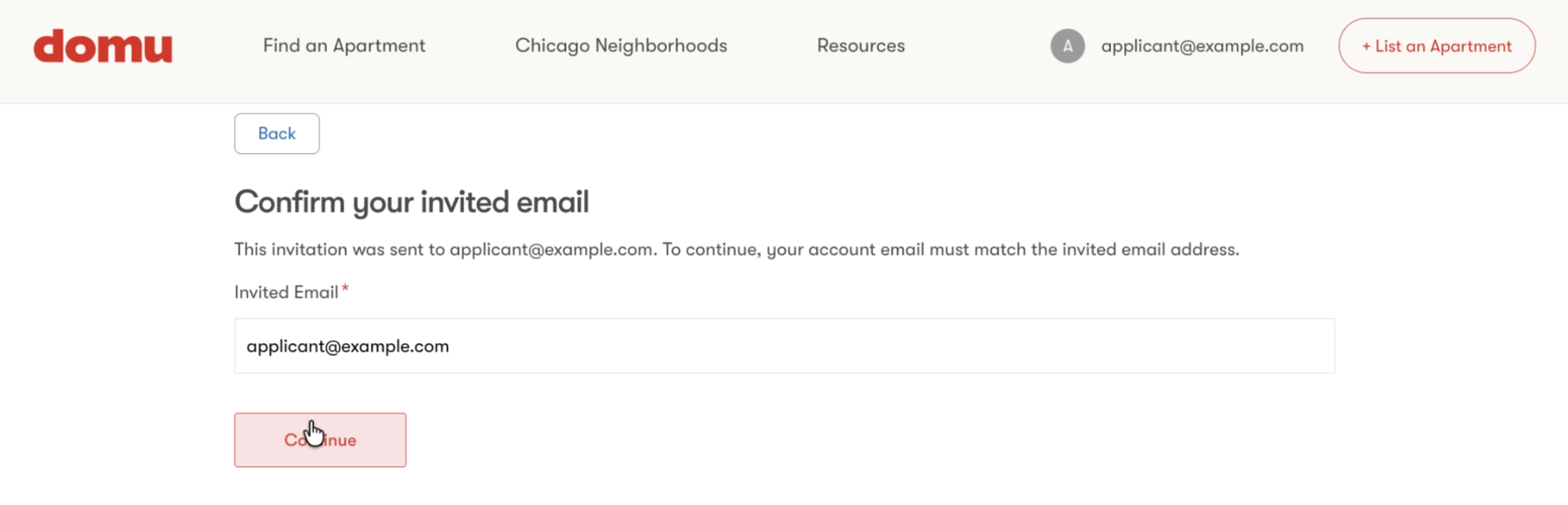
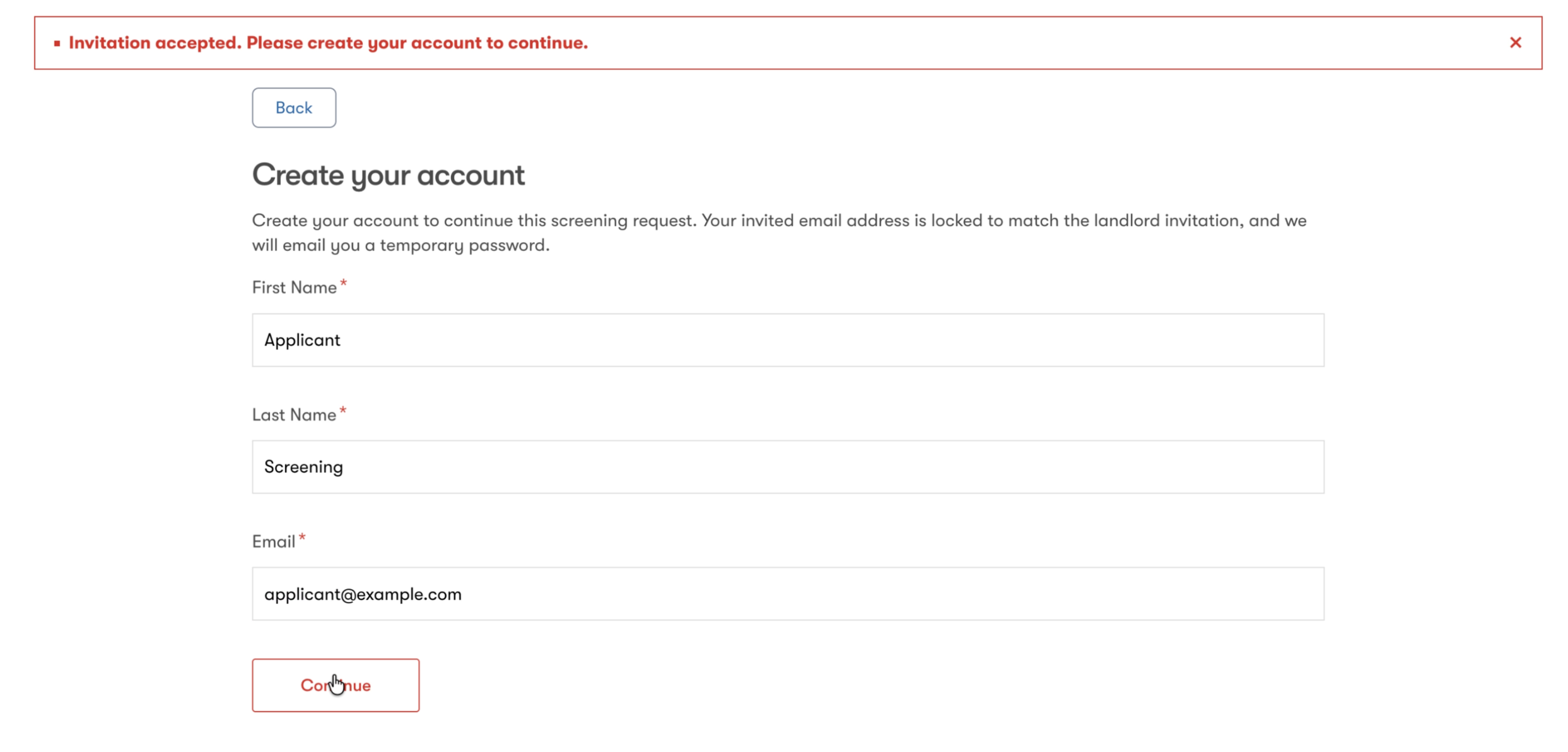
If you're new to Domu, you'll be asked for your first name, last name, email, and a password. The invited email is prefilled and locked: that's the address tied to this request.
Step 03
Fill out your renter profile
Before screening begins, select whether you are applying as a Tenant or Co-signer.
Next, you'll enter the information TransUnion needs to verify your identity and pull your reports. Have these ready:
- Full legal name (first, middle, last)
- Phone number
- Current home address (the one your ID and credit file are registered to)
- Social Security number
- Date of birth
- Stated monthly income, income frequency, and employment status
Type carefully. If your name, address, date of birth, or SSN is entered slightly differently than what the credit bureau has on file, you may be asked extra identity verification questions in the next step.
Your SSN is securely sent to TransUnion to verify your identity and pull your credit file. Domu does not store your SSN or other sensitive information such as your date of birth, income details, or identity verification data. None of this information is shown on the report shared with landlords.
Step 04
Accept the TransUnion terms
Before identity verification runs, you'll review and accept TransUnion's terms for the screening. This is the standard authorization that lets TransUnion pull your credit, eviction, and criminal background data on your behalf.
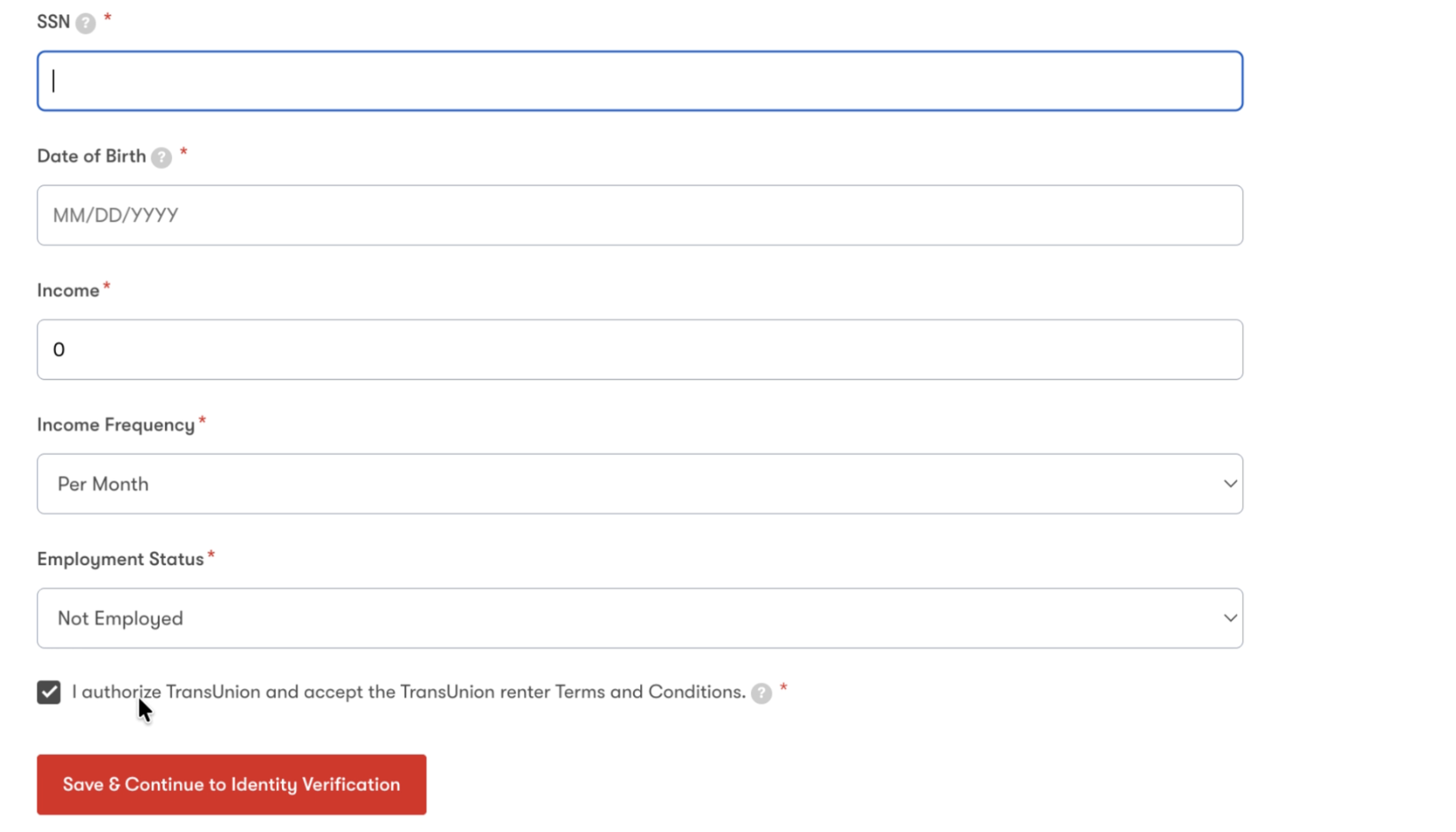
Read it, check the box, and continue.
Step 05
Verify your identity
TransUnion runs a short identity quiz drawn from your credit file, which generally asks questions about old addresses, accounts, or employers you've had. The questions can feel obscure, especially if they reach back several years. That's normal.
You get two attempts at the online quiz. If you don't pass within those two tries, you'll be directed to verify by phone.
If you pass online, you move straight to payment. Online verification is usually instant.
If the online quiz can't verify you, you'll see a message with a screening reference ID and a phone number for TransUnion support: (833) 458-6338. Call them with the reference ID to verify by phone. This happens for plenty of normal reasons (ex. you moved recently, you have a thin credit file, you have a credit freeze in place) and it's not a problem with your application.
Manual verification typically takes 24 to 48 hours after TransUnion has what they need from you. In rare cases, usually when documentation is incorrect or incomplete, it can take 3 to 5 business days. Once TransUnion confirms your identity, your status updates automatically and you'll get an email telling you to continue.
Step 06
Pay the $50 screening fee
After your identity is verified, you'll reach the payment page. The fee is a flat $50, paid once. You'll enter your card and confirm.

You're not charged anything until this step. If you abandon checkout without completing payment, no charge goes through and your application stays in payment_pending status until you finish.
Step 07
Wait for your reports
After payment clears, TransUnion generates your reports. Most come back within minutes. Some take a few hours, and in rare cases up to a few days.

You and your landlord get the same email notifications as each report becomes available, at the same time. You can check your Domu dashboard at any time. Note that the report cards switch from NOT READY to READY as each one is generated.
| Status | What it means |
|---|---|
| Pending | Invite sent, you haven't started yet |
| In Progress | You've started filling out your info |
| IDV Failed | Online identity verification didn't go through; call TransUnion to verify by phone |
| Payment Completed / Paid | Payment received; reports are being generated |
| Phase 1 Reports Ready | Credit and eviction reports are available for your landlord's review |
| Phase 2 Reports Ready | Criminal report is available, after your landlord conditionally approves |
| Approved / Declined | Your landlord has recorded their final decision |
Step 08
Understand the Cook County two-phase review
Domu's screening releases reports to your landlord in two phases. Your credit and eviction reports come back first. Your criminal background check stays locked until your landlord has reviewed Phase 1 and conditionally approved your application.
This sequence is required by Cook County's Just Housing Ordinance, which has been in effect since December 31, 2019. The ordinance requires landlords to evaluate applicants on credit, income, and eviction history before looking at any criminal record. Most national screening tools deliver everything in one click. Domu's doesn't, by design. Read more about the Just Housing Ordinance.
Step 09
Reuse your screening for 30 days
Your completed Domu screening is reusable for 30 days across other Domu landlords at no additional cost. If you're applying to multiple apartments, that means one $50 fee covers your full search window (provided every landlord you apply to is on Domu).
How it works:
- Another Domu landlord sends you a screening invite
- You accept it; your existing profile loads automatically
- If your identity verification is still valid, you skip the quiz
- You skip the $50 payment
- Fresh reports are pulled and shared with the new landlord
After 30 days, a new screening requires a new $50 payment.
Step 10
Get the landlord's decision
Once your landlord makes a final decision in their dashboard, you'll receive an email. Approved or declined, you'll know.
If something on your report looks wrong (ex. an account that isn't yours, an eviction filing you don't recognize, an outdated address) you can dispute it directly with TransUnion at TransUnion's dispute center. Disputes typically take 30 days to resolve. In the meantime, let your landlord know you've filed one. Most landlords will hear you out, especially if you can show documentation supporting your side.
If your credit score comes back as N/A, meaning the bureau couldn't generate a score, often because you have a thin credit file or are new to U.S. credit, talk to the landlord directly. Many will accept a thin file with steady employment, references from previous landlords, bank statements, or a cosigner.
FAQs For Tenants
Getting Started
Application basics, request form fields, and credit pull mechanics.
Soft pull. Domu's screening uses TransUnion's tenant-screening product, which performs a soft credit inquiry. Soft pulls show up on your credit report only when you view it yourself: they're invisible to other lenders, landlords, or credit decision-makers, and they don't affect your score.
Almost always, this is an email mismatch. The email address your landlord used to invite you has to match the email on your Domu account. If they're different, the system won't let you open the request.
You have two options:
- Update your account email to match the address your landlord invited. The system will offer this as a checkbox when you log in.
- Ask your landlord to resend the invite to the email already on your Domu account.
Either path works: pick whichever is easier. If you don't have a Domu account yet, you'll be prompted to create one with the invited email address automatically.
TransUnion's tenant screening currently requires a valid U.S. Social Security number to pull a credit, eviction, or criminal background report. If you don't have an SSN (for example, you're a recent immigrant, an international student, or you have an ITIN instead) you won't be able to complete the screening through Domu.
In these cases, we recommend that you talk to your landlord directly. Many Chicago landlords accept alternative documentation for applicants without an SSN: passport, visa, ITIN, employment offer letter, bank statements, references from previous landlords, or a U.S.-based cosigner.
Your landlord is verifying you're a financially stable applicant before signing a lease, the same way you might check reviews before booking a hotel.
Domu's screening gives them a clear, current picture from TransUnion: your credit history, any past evictions, and (in Cook County, only after they've reviewed your credit and eviction history first) a criminal background check. The goal isn't to dig into your life, but rather to give the landlord enough information to make a confident decision and offer you the lease.
No. Because the screening uses a soft credit pull rather than a hard inquiry, applying through Domu has zero impact on your credit score — even if you apply for multiple apartments.
Hard inquiries (the kind that can briefly lower your score) happen when you apply for a credit card, car loan, or mortgage. Tenant screening doesn't work that way.
Put the address where you currently receive mail and where your ID is registered, even if it's temporary. The screening uses your current address to confirm your identity against credit bureau records, so it needs to match what the bureaus already have on file for you.
Common situations:
- Staying with family or a friend short-term: use your previous lease address if your ID and bank statements still go there. Otherwise, use the address where you're currently receiving mail.
- Just moved to Chicago: use your prior out-of-state address. The system can handle this.
- Between leases / no fixed address: use the address on your driver's license or state ID.
If your address doesn't match what the credit bureau has on file, you may be asked extra identity verification questions, but you won't be rejected for it.
You're not obligated to complete a screening just because a landlord sent you an invite. If you've changed your mind about the apartment, no need to begin an application for no reason. It would be courteous to reach out to the landlord directly to let them know your decision.
Privacy & Data Security
How your information is collected, stored, and shared.
TransUnion, one of the three major national credit bureaus. The credit, eviction, and criminal background data on every Domu screening comes directly from TransUnion's source data.
Eviction records cover Cook County, Illinois statewide, and nationwide court records. Criminal background covers nationwide databases.
A legitimate Domu screening invite always comes from a domu.com email address and links to a page on domu.com. Real invites also reference a specific property and the name of the landlord who sent it.
Red flags to watch for:
- The invite asks you to wire money, pay in gift cards, or pay anyone other than Domu
- The screening fee is anything other than $50, or a landlord asks you to pay them directly for the screening
- The invite asks for sensitive info outside of the secure Domu form (no legitimate screening will ask you to email your SSN, for example)
- Pressure to pay or sign before you've seen the property
- The "landlord" can't or won't show the property in person or via live video tour
Domu has been Chicago's apartment marketplace since 2010 and answers every phone call with a real human. If something feels off, contact us before you pay or share anything sensitive — we'll tell you whether the request is real.
Your Social Security number is sent securely to TransUnion to verify your identity and pull your reports. Domu does not store your full SSN in a way that's visible to landlords or accessible from your account.
No. Your full SSN is never shown on the report the landlord receives.
TransUnion uses your SSN internally to verify your identity and pull the right credit file, but the report itself does not display it. Landlords see your name, date of birth, addresses on file, credit history, eviction history, and (after Phase 1 review in Cook County) criminal background, but not your SSN.
Identity Verification
How to pass the quiz, complete manual verification, and provide further documentation.
You don't pay anything until you've successfully completed identity verification. The order is:
- Accept the screening invite and log in (or create your account)
- Fill out your renter profile (name, address, SSN, income, employment)
- Pass identity verification (online quiz or manual phone verification)
- Pay the $50 fee
- Reports are pulled and shared with your landlord
If you can't get through identity verification, you don't pay.
A failed online verification doesn't mean your application is in trouble. It just means TransUnion's quiz couldn't confirm your identity from the data points it had, which can happen for plenty of completely normal reasons.
Common reasons the online quiz fails:
- You moved recently and the bureau hasn't updated your address yet
- You have a thin credit file (new to credit, recent grad, recent immigrant)
- The quiz asked about an old account or address you don't remember clearly
- You have a credit freeze in place
- Your name, address, or SSN was entered slightly differently than what the bureau has on file
When the online quiz doesn't work, you verify manually by phone with TransUnion. Your landlord sees your status update in real time, so they can confirm that you're working through the process.
A credit freeze restricts access to your credit file, which can prevent TransUnion from completing identity verification or pulling your credit report.
If your screening doesn't go through and you have a freeze in place, call TransUnion directly. They can walk you through your options, since Domu can't lift, modify, or work around a credit freeze.
You get two attempts at the online identity verification quiz. If you don't pass within those two tries, you'll see instructions to call TransUnion Support at (833) 458-6338 to complete verification over the phone. The message will include a screening reference ID — keep it handy for the call.
Manual verification is a normal path. It happens to a lot of people for a lot of reasons, and it doesn't reflect badly on your application.
Manual verification by phone with TransUnion typically takes 24 to 48 hours after they have what they need from you. In rare cases, usually when documentation is incorrect or incomplete, it can take 3 to 5 business days. Call them at (833) 458-6338 with the screening reference ID shown in your dashboard.
Once TransUnion confirms your identity, your status updates automatically in Domu and you'll get an email letting you know to continue to payment.
Your identity verification stays valid for 30 days. If you update your profile information during that window (name, address, date of birth, SSN) TransUnion will require you to re-verify.
If your information hasn't changed, use your existing verified profile rather than editing it. That way you stay inside the 30-day reuse window and skip the quiz on your next application.
Understanding Reports
What's on each report, what the scores mean, and how to fix errors.
You'll get an email each time a report becomes available. You can also log into your Domu dashboard at any time to check status: the report cards will switch from "Not Ready" to a clickable "View Report" link as each one is generated.
Most reports are ready within minutes of submitting your payment. However, some may take a few hours, and in rare cases, up to 3 business days.
We do not recommend downloading or saving reports locally. If you want to share your report with another landlord, ask them to send you a screening invite through Domu if possible. You can then share your existing report using the 30-day multi-share feature. This helps ensure both the landlord and listing are verified through TransUnion, reducing the risk of scams or fraudulent listings.
While Domu doesn't have a download button for renter reports, you can save a copy yourself using your browser's print function (File → Print, or Ctrl/Cmd + P) and selecting "Save as PDF" as the destination.
If you save a copy, don't edit, alter, or remove the timestamp. TransUnion's reports are time-sensitive, so the date the report was generated tells any landlord reviewing it whether the data is current. A report without a clear, unaltered timestamp may be rejected, and altering a screening report defeats the purpose of having one.
Court records of any eviction filings or judgments under your name, drawn from Cook County, Illinois statewide, and nationwide databases. A clean report shows no records found.
View a sample eviction report.
Domu can't edit, remove, or correct items on your credit, eviction, or criminal report. To fix incorrect information, you'll need to dispute it directly with TransUnion.
You can file a free dispute online at TransUnion's dispute center. Disputes typically take 30 days to resolve.
In the meantime, let your landlord know you've filed a dispute and provide context. Most landlords should hear you out, especially if you can show documentation supporting your side.
You and your landlord see the same reports. The credit, eviction, and criminal data displayed is identical on both sides; there's no hidden information about you that's visible only to the landlord.
Your TransUnion credit report includes:
- Credit score — TransUnion's tenant-screening score, typically on the standard 300–850 scale. Most landlords look for 620+ as a baseline, though it varies by property and market.
- Payment history — your record of paying credit cards, loans, and other accounts on time
- Open accounts and balances — what you currently owe
- Bankruptcies, collections, public records — anything significant in your financial history
Want to see what a real one looks like? View the sample credit report.
For a deeper dive on credit scores specifically, read What credit score do you need to rent an apartment in Chicago?
Nationwide criminal database results. In Cook County, the landlord can only see this report after first reviewing your credit and eviction history and conditionally approving you, as required by Cook County's Just Housing Ordinance. Read more about how the Just Housing Ordinance protects renters.
In Cook County (which covers nearly all of Chicago), it's the law. Cook County's Just Housing Ordinance requires landlords to evaluate your qualifications (credit, income, eviction history) before looking at any criminal record. The goal is to make sure people aren't rejected from housing on the basis of criminal history before they've even been evaluated on the standard rental criteria.
Most national tenant screening tools deliver everything in one click. Domu doesn't, but this is by design and for your protection: Your credit and eviction reports come back first, your landlord reviews them, and only after you've been conditionally approved at that stage does the criminal background check unlock for them.
Report Timeline & Usage
Reusing your reports, applying off-Domu, and what to expect by email.
Once you've completed and paid for a Domu screening, your verified profile and payment are good for 30 days. During that window, you can apply to other Domu apartments at no extra cost, and each new landlord still receives fresh reports.
Here's how it works:
- Another Domu landlord sends you a screening invite
- You accept the invite and your existing profile auto-loads
- If your identity verification is still valid (within the same 30-day window), you skip the quiz
- You skip the $50 payment
- Fresh reports are pulled and shared with the new landlord
After 30 days, a new screening requires a new $50 payment. This is a TransUnion rule, not a Domu rule — it ensures every report stays current.
You'll receive emails at these key points:
- Screening invite — when your landlord first sends you the screening request. This is the email with the link to start the application.
- Manual verification completed — if you had to verify your identity over the phone with TransUnion, you'll get this email when verification is confirmed, telling you to continue to payment.
- Screening payment confirmation — sent right after your $50 payment goes through.
- Report ready — sent each time one of your reports becomes available to view.
- Application decision — when your landlord marks your application approved or declined, you'll get an email letting you know.
Tip: add Domu to your email contacts so these don't end up in spam. If you're waiting on something and haven't gotten an email, check your spam folder before assuming there's a problem.
Depends on the landlord. Your Domu reports come from TransUnion and they're timestamped, but many landlords (especially larger property management companies) require their own screening platform.
Either way, it's a good idea to confirm with the landlord before you begin a second application.
Yes. If a landlord outside of Domu wants to use your existing screening, ask them to create a free Domu landlord account and send you an invite. Your reports auto-populate within the 30-day reuse window — no new payment from you, no charge to them.